FreeLynx Input Configurations
This TechTip is part of our series familiarizing researchers with wireless electrophysiology technology.
Equipment selection for electrophysiology experiments often starts with the animal interface — the direct conductive pathway into the subject’s tissue — and flows out from there. The assumption is that once we have successfully conducted target neural signals, preserving any relevant natural behavior required by the experiment, the easier task will be to amplify and carry the signals to an acquisition system with any necessary combination of connectors, adapters, tethers, and commutators. The process is similar when using a wireless telemetry system. However, any connectors and adapters between the animal interface and the wireless transmitter must constrain to a weight and size that the subject can carry during experiment behavior.
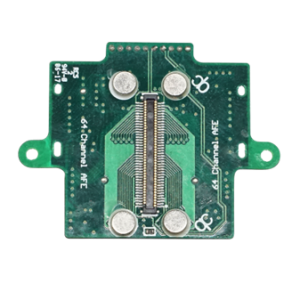 QuickClip® AFE module mounts FreeLynx directly to a QuickClip 64 channel connector.
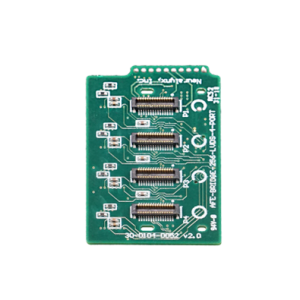
LVDS Bridge Board module accepts 1 – 4 mini-tethered inputs.
To maximize implant compatibility within size constraints, the FreeLynx system uses a separate front end input module customizable to accept a wide variety of animal interfaces, channel counts, and mounting options with minimal changes to system size and weight. The table below includes some common configurations using standard components.
FreeLynx / Animal Interface Compatibility Chart (Not Comprehensive)
| Model | Type | Connector | Channels | Mounting |
| Halo-18 Microdrive (Neuralynx) |
Tetrodes | QuickClip 72 | 64 | Direct |
| ASSY-116 / ASSY-158 (Cambridge NeuroTech) |
Silicon Probes | Dual Omnetics NPD-36 | 64 | Direct |
| Omnetics 32-Chronic (Atlas Neuro) |
Silicon Probes | Dual Omnetics NPD-36 | 64 | Direct |
| CM/OCM/H/HC/P Series (NeuroNexus) |
Silicon Probes | Dual Omnetics NPD-36 | 64 | Direct |
| Custom Microdrive | Tetrodes | Custom | 96 | Direct OR Mini-Tethered |
| ASSY-116, ASSY-156, ASSY-158 (Cambridge NeuroTech) |
Silicon Probes | Omnetics NPD-36 (1-8) | 256 | Mini-Tethered |
| CM/OCM/H/HC/P Series (NeuroNexus) |
Silicon Probes | Omnetics NPD-36 (1-8) | 256 | Mini-Tethered |
| Omnetics 32-Chronic (Atlas Neuro) |
Silicon Probes | Omnetics NPD-36 (1-8) | 256 | Mini-Tethered |
| Mini-Amp-64 (Cambridge NeuroTech) |
Headstage + Probes | PZN-12 (1-4) | 256 | Mini-Tethered |
Due to the flexibility of this design, it is very likely that a FreeLynx can be configured to work with any other animal interface you choose to use, granted we have enough lead time to produce intermediate components. Please contact us to discuss wireless solutions for your next experiment.
Caution – Device for investigational use in laboratory animals or other tests that do not involve human subjects.
Rev. A0